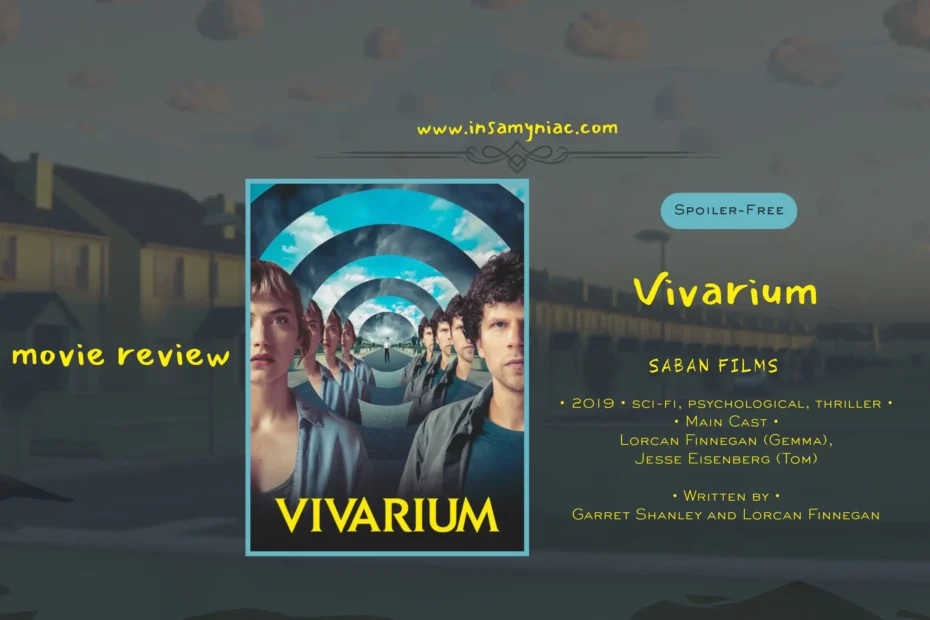
Let me be upfront: I did not enjoy Vivarium, a 2019 sci-fi psychological thriller. I found it slow, and didn’t get the point of it immediately. And yet — here I am, writing a review, still thinking about it, deciding to write about it because at some point, it wasn’t a bad-bad movie. So this review is a bit unusual: it’s for everyone who watched Vivarium and felt nothing, and everyone wondering whether they should bother.
The premise of Vivarium
Directed by Lorcan Finnegan and starring Jesse Eisenberg and Imogen Poots, Vivarium follows a young couple searching for their first home. Their search leads them to Yonder — a spotless suburb where every house is identical and every lawn the same unnatural green. It seems perfect. Then things start to go wrong. I’ll stop there — the film works best if you know as little as possible — but the marketing tagline of “domestic thriller” undersells what it really is: ninety-eight minutes of purgatory, and I mean that almost literally. The movie is about being trapped in a script.
The honest part: I was bored
I won’t pretend otherwise. If you go into Vivarium expecting a plot-driven thriller — twists, answers, escalating stakes — you will likely be as bored as I was. The story is deliberately narrow, the pacing is glacial, the mystery never explains itself, and some of the symbolism is about as subtle as a brick through a window. Sections drag. The film wants you to feel trapped and repetitious and stuck — and mission accomplished, except “feeling trapped” is not the same as “being entertained.” For large stretches, I felt like I was living the movie instead of watching it, and not in the flattering way a director would intend.
The part that saved it for me: what it’s actually saying
Then I read about what the film was actually telling — and suddenly, everything made sense, and the boredom retroactively became the point.
Because Vivarium isn’t really about a couple trapped in a suburb. It’s a fable about the script of Life that gets handed to you: buy a house, pair up, follow the expected stages, dissolve into the routine, and be replaced by the next couple doing exactly the same. It hands you that script the way life does — one apparently reasonable step at a time. Nobody in Yonder wrote it; everyone is simply executing it. Once I saw that, the repetitive, airless sameness that bored me wasn’t a flaw — it was the subject. The film is the boredom of a pre-written life, and I was resisting it exactly like the characters do.
And that’s where I have to hand it to the filmmakers: the real horror isn’t a monster or a twist. It’s expectation and perfectionism as an inescapable system — the staged perfection of Yonder, the pressure of the role you’re supposed to play, the quiet terror of realizing your life is a template you didn’t choose. Viewed that way, it’s genuinely chilling.
The part I liked even before I understood it
Even in my bored first-watch state, two things stood out as objectively excellent.
The performances: Imogen Poots (Gemma) carries the film, fraying from polite concern to exhaustion to quiet despair, and you feel every stage of it. Jesse Eisenberg (Tom) plays against his usual nervous-charm type as the flatter, harder-edged Tom. And the young actor playing the child is unforgettable — an eerie mimicry of humanity that never quite lands on it. Whatever the film needed its actors to endure emotionally, they deliver.
The colors and staging: Yonder is stunning in the wrongest possible way. Lurid greens, sterile whites, skies painted by someone who has heard of sky but never seen one. The identical houses aren’t just a backdrop; the geometry is disorienting in a way that mirrors the characters’ unraveling minds. Visually, this is one of the most distinctive films.
Final thoughts
So where does that leave me? Honestly: torn, but impressed. I can’t in good conscience call Vivarium an entertaining movie — it didn’t get me, and I believe it’s designed to. But I also can’t shake it, and I now think that was entirely the intent. It’s a rare film that converts its own flaws into its message; the trick only reveals itself after the fact, which I suspect is why opinions are so violently divided.
Watch it if you like slow, metaphor-heavy cinema — The Lobster, mother!, punishing Black Mirror episodes. Know in advance that the payoff is thematic, not narrative, and maybe read a think-piece or two afterward; it transforms the experience.
💬 Have you seen Vivarium? Were you bored like me — or hooked from minute one? Did understanding the metaphor change it for you too? Let me know in the comments!